
Dall’iCub a Generative Bionics: la robotica e il futuro che abbiamo costruito insieme

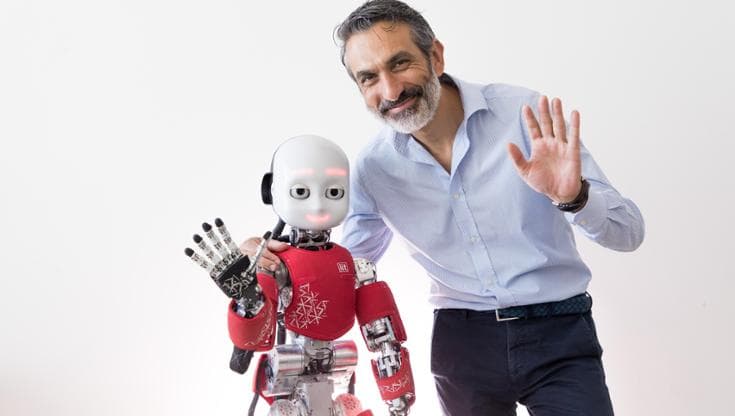
Giorgio Metta, Scientific Director of the Italian Institute of Technology, with the robot iCub
If I were to highlight a milestone in my career within the robotics field, I would reflect on the early 2000s when, after returning from two years at MIT in the United States, I, alongside Giulio Sandini, secured funding to develop a small humanoid that could serve as a benchmark for the international robotics community. We named it iCub, and at that time, it felt almost like science fiction.
iCub was more than just a robot; it was an open and long-term platform. Its purpose was to investigate learning through the interaction between the robot and its surroundings, as well as human-robot interaction, while simultaneously inspiring a new generation of roboticists. The potential applications ranged from industry to assisting individuals in their daily lives. During those same years, the Italian Institute of Technology was established in Genoa, under the leadership of Roberto Cingolani, with iCub quickly becoming its emblem.
However, the story of iCub is not solely about a robot; it is primarily about the individuals it has trained in research, technology, and business. Over the years, IIT’s robotics sector has flourished, evolving into a nurturing ground for talents who now carry that vision forward globally.
In 2013, Daniele Pucci began working on iCub after completing a PhD in aerospace engineering, training under Francesco Nori, who was then a researcher at IIT and is now the director of the robotics lab at Google DeepMind in London. Together with Alessio Del Bue, Marco Maggiali, and Andrea Pagnin, a blend of expertise emerged, encompassing artificial intelligence, robotics, economics, and industrial design, all converging around that initial humanoid robotics and AI study platform, capable of attracting talent. This collaboration led to a crucial piece of the Genoese Robot Valley: the startup Generative Bionics.
Generative Bionics philosophically stems from a branch of iCub and technologically from the ergoCub project, developed by IIT in collaboration with INAIL. It is the forty-first startup emerging from IIT research, the largest among them, and likely the most significant academic spin-off in Europe. The aim is to create intelligent and sophisticated humanoid robots that can be integrated into daily life and work alongside humans. This serves as a tangible example of how public investment in fundamental research can yield real value for society and the national economic system.
The company has attracted a consortium of high-profile investors, including CDP Venture Capital, AMD Ventures, Duferco, Eni Next, RoboIT, and Tether, with a total investment of 70 million euros. These are significant figures for the Italian innovation ecosystem and a solid foundation for competing at both the European and global levels.
Meanwhile, the international landscape of humanoid robotics is experiencing extraordinary acceleration. Giants like Tesla, Figure.ai, Xiaomi, and numerous Chinese enterprises are investing billions in developing machines capable of moving, learning, and interacting in complex environments. These systems are powered by artificial intelligence, including generative AI, and increasingly advanced control architectures, set to transform manufacturing, logistics, assistance, and home environments. Italy, bolstered by its tradition in mechatronics and industrial robotics, now has a genuine opportunity to enter this rapidly growing market.
Today, we recognize that the value of an institution like IIT is not solely measured by scientific achievements, but also by the individuals it has trained and the ideas it has nurtured. If Italy has a role in global robotics, it is also due to this ecosystem of shared talents and visions.
But this is not the conclusion of the story. IIT is always moving forward. While companies bring technologies into factories, our role remains to envision the next leap. Humanoid robotics still needs to evolve to step out of future factories and become more human-like in interaction. Not androids, but robots with flexible mechanisms, gentle interactions, great dexterity in manipulation, tactile sensors inspired by skin, flexible electronics, and cognitive architectures derived from neuroscience. Not incremental evolution, but a paradigm shift.
In a rapidly aging society, robotics will become increasingly necessary. IIT interprets it as an integration of materials science, microelectronics, neuroscience, and artificial intelligence. A unique place that embodies the dream of a true Robot Valley, of which I am proud to be a part.
*Scientific Director of the Italian Institute of Technology
